Check this out: Loni Townsend’s new book trailer

Loni Townsend recently posted a new book trailer over at her blog, Squirrel Talk. The trailer is for her novel, Thanmir War, now available on Amazon.

She’d love some feedback, so if you’d like to tell her what you think, click here and leave her a comment.

Click full screen for it to play. Thanks and enjoy!


Maps

I love maps. Whenever I pick up a new fantasy novel to read, the first thing I do is look to see if there’s a map of the fictional world I’m about to enter. Maps of these imaginary worlds are so much fun to study — the rise and flow of the landforms and bodies of water, the boundaries of the kingdoms, and the placement of cities and towns. And the names — that’s what I enjoy the most, reading all the names and getting a feel for how they sound and what kind of images those sounds evoke in my mind. It doesn’t matter if they’re everyday words or if they’re exotic or fantastical. Any name can spark my imagination.

Drawing maps is even more fun. Before I started writing my first novel, I had already drawn maps of the world my characters inhabited, and rough sketches of some of the important places. From these beginnings, my stories build, my characters living day to day in a paper land that’s so real in my mind’s eye. I’ve always found it easier to have that visual when trying to figure out the timing and spatial aspects of a story, like how long it would take this person to travel here versus this group traveling there, and questions of that sort. It makes everything seem more concrete to me. I refer to my maps all the time when I’m writing, just as I regularly flip back to the maps I find in fantasy novels, to better follow the characters’ progressions through the story.

I’ve been putting the finishing touches on the map that goes with my soon-to-be-published book. I tweaked a few of the names of the towns and kingdoms to make them more unique, and changed a couple of them entirely when I discovered the names had already been used on other maps in other books, or had previous proprietary claims (such as the kingdom name I “created” which turned out to be the same as a trademarked drug belonging to a pharmaceutical company). When I first drew this map back in the mid-1980s, I never thought about whether anyone else had used the names before. Now, I do Internet searches on every name, for both places and people, to try to avoid inadvertent conflicts. But since I’ll never be able to read every book ever published or every map or character name from every online gaming world out there, I know it’s impossible to avoid all duplication. I try, though, unless it’s a common name or household word, in which case it’s not as important.

I can’t wait until the day I see my map spread out in the front pages of my own book. Soon.

ISBNs!

I’m so excited! I am now the happy owner of a block of ISBN numbers! I know it sounds kind of silly to get excited over a bunch of numbers, but these aren’t just any numbers. These numbers bring me one step closer to my dream of being a published author. I can look at the row of digits and picture them on the back of my soon-to-be book cover — the cover that will wrap around my creation and hopefully entice potential buyers to take a look. The ISBN that I assign to my book will be registered in the Library of Congress and will appear in book listings worldwide. Whoa! Deep breath…

I purchased the ISBNs from Bowker Identifier Services at www.myidentifiers.com/isbn/main. In the process, I discovered that Bowker also has a Web site at www.selfpublishedauthor.com with information for those embarking on the self-publishing path. I haven’t gone through much of it yet, but on first glance, it looks like it will be a useful resource. On the bottom right side of the home page, I found a list of a dozen links to more great resources for writers: The Book Designer, Writer Beware: The Blog, Writer’s Digest Blog, and the Independent Book Publishers Association, to name a few. Well worth checking out. I know I’ll be back soon to read more.

But for now, I’m going to go look at my ISBN numbers again and smile for the rest of the day. 🙂

Quality, or Lack Thereof

I haven’t read many self-published books. I never really thought about it until I decided to go the self-publishing route with my own novel. So far, the ones I’ve read have run the gamut from having only a few typos and a small need for editing to having so many typos, misspellings, tautology, etc., that it was hard to keep my head in the story.

I know there are reviewers out there who refuse to review self-published books, and those who have read them bemoan this lack of quality — and rightly so. With all the resources available to writers there’s no reason self-published books shouldn’t be on par with the majority of traditionally-published books.

I say the majority because I’ve read a few traditionally-published novels lately with a surprising number of typos and/or misused words. I don’t know if it has always been this way or if I’m just noticing it more since I’ve become more serious about my own work, but the fact is, traditionally-published books are not perfect.

Photo credit: Amazon

Photo credit: Amazon

Take the book I’m reading right now, for example: Aurian by Maggie Furey, published by Bantam Spectra in 1994. I discovered to my extreme annoyance that this book is missing over 30 pages. Half of chapters 16 and 18 and all of chapter 17 are not there. The page numbers go up through 250, then pages 219 through 250 are repeated, and then the story continues on page 283. Before the break, the villain is whole and plotting the destruction of Aurian, who has escaped his clutches by ship. When the story picks up again, the villain is blinded and bedridden and Aurian’s ship has been wrecked. What happened? If I want to know, I have to order another copy of the book (none of the local libraries have one) and hope it is complete.

I don’t know what happened there with quality control, but it’s certainly worse than any problem I’ve had with a self-published book. And while I know this is an isolated occurrence, I hope that readers will realize that traditionally-published books can have mistakes in them — and sometimes plotting and character development problems too — and that it’s unfair to put them on so lofty a pedestal above those that are self-published. I also hope that self-publishers will do their part to bring their books to a higher level of quality and help abolish the stigma attached to them simply for being self-published.

I will do my utmost to reach that level.

Judging A Book By Its Cover

I’ve been researching book cover design to learn more about what sells and what doesn’t. In that all-important first moment when potential buyers see your book either online or on a brick-and-mortar store shelf, does the cover grab them and shout “Buy me!” or does it say “Meh” and let them get away?Book_I_WhiteCover

I read that analyzing covers of recently published books is a great way to get ideas that will make your book an eye-catcher. Sometimes I found it difficult, though, to figure out why some covers worked better than others. For example, on The Book Designer Web site, Joel Friedlander critiques book covers submitted by writers/designers, awarding gold stars to the best ones and useful comments to others. I went through and studied the covers, then read his comments to see if we had similar thoughts. Sometimes we agreed and sometimes not. The crux of the matter is that it’s all subjective. One person’s beauty is another’s bleh.

The site did have some good basic design tips which I found helpful.
• Decide what your principal focus will be and work around that. Use only a few images and don’t clutter.
• Don’t use a white background. Use texture, color, or illustration instead.
• Make sure the text stands out and is easy to read.
• The title needs to be large enough to be read when shrunk to Amazon thumbnail size.
• Use images, colors, and fonts that convey the tone/mood of the book.

A few seconds’ glance is all you get when someone picks up your book. In those few moments, your cover should communicate the genre, the theme or basic subject of the book, and the tone. It should lead the person into your story and make them not want to leave. I know that sounds like common sense, but it’s a lot harder than it seems.

I had some general ideas of what I thought should be on the cover of my book, one of which was to focus on my main character, a swordswoman with silver-blonde hair. Both the book I’m currently reading and the one I’m going to read next have swordswomen prominently on the covers. But then I read where one person didn’t like putting characters on book covers because she preferred to leave the characters’ faces to the readers’ imaginations.

What do you think? Does it bother you to have an image of the main character on the book cover? I’d love to hear your opinions!

A to Z Challenge: Fictional Favorites, Day 26

Z is for — Zorro, from Johnston McCulley’s classic adventure, The Mark of Zorro

Swish, swish, swish. Three flicks of the blade carve the infamous Z as Zorro leaves his mark on another adversary. Dressed all in black, his face hidden behind a black mask, the legendary hero of 1820s Spanish California rides to the rescue of the poor and oppressed, fighting injustice like a Robin Hood of the old west. Don Diego de la Vega, nobleman and wealthy landowner, plays the vapid fop in public while hiding his secret identity as the masked highwayman.

Zorro (Spanish for fox) was originally created by McCulley in 1919 as a five-part serialized story entitled The Curse of Capistrano — the nickname given Zorro by the corrupt politicians and soldiers for his constant bedeviling. The 1920 silent film with Douglas Fairbanks further popularized the tale. McCulley penned over 60 stories of the adventures of Zorro, and the character has since been immortalized in many other film and novel and television adaptations.

I always liked the Disney TV series with Guy Williams that originally ran from 1957 to 1959. I remember watching the reruns as I was growing up. I’ve also seen the 1920 Fairbanks movie and both movies with Antonio Banderas, from 1998 and 2005. On my to-be-watched list are the 1940 film with Tyrone Power, the 1990s series with Duncan Regehr, and some of the animated versions.

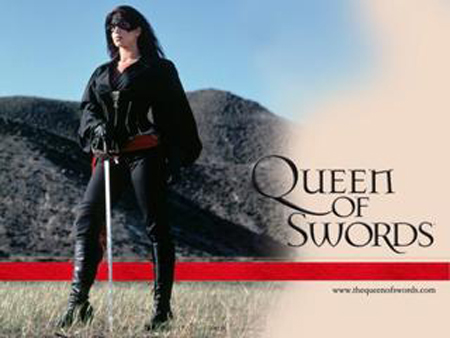
Best of all, though, I liked the Queen of Swords — Zorro with a twist: a female swordswoman in a black mask, fighting injustice in early 19th century Spanish California. The TV series with Tessie Santiago ran for one season from 2000 to 2001. Given the scarcity of female sword-wielding action heroes, I so wish it had run longer.

Z_MarkOfZorroBook

Z_ZorroDisney

Tessie Santiago as Tessa Alvarado in The Queen of Swords

Tessie Santiago as Tessa Alvarado in
The Queen of Swords

A to Z Challenge: Fictional Favorites, Day 21

U is for — Queen Upsteeplebat, from Tad Williams’ Shadowmarch series

When I first read the name Queen Upsteeplebat, I thought to myself, What kind of a name is that? Being a reader of fantasy and science fiction, I’ve run across some odd names before, but that has to be one of the strangest. And such a huge, long name for such a tiny person. “Her Exquisite and Unforgotten Majesty,” Queen Upsteeplebat is the leader of the Rooftoppers, a race of little people similar to Lilliputians or Mary Norton’s Borrowers. They live in the towers and forgotten places of Shadowmarch Castle. Rooftopper warriors ride trained mice and wear nutshell armor and helmets made from bird skulls. The queen rides a white dove and her regal bearing commands respect from everyone, large or small. Williams describes her thus: She “rode directly between the dove’s wings with her legs curled beneath her and the reins little more than a sparkling cobweb in her hands. Her gown was brown and gray, rich with ornament, and her hair was dark red.” She “was not so much pretty as handsome, with a fine, strong-boned face and eyes that looked up … without any discernible fear.”

Queen Upsteeplebat and the Rooftoppers meet with one of the Funderlings (Dwarf-like people) to warn him of the evil that is rising beneath Shadowmarch Castle. Beetledown the Bowman, a Rooftopper gutter-scout, aids the Funderlings and is instrumental in dealing a crippling blow to the enemy in the final battle in the fourth book of the series, Shadowheart. Though the Rooftoppers are supporting characters rather than main characters, I found them endearing and more interesting than most of the other characters in the books. Their bravery and sacrifice equaled that of those a hundred times their size.

U_TadWilliamsBooks

A to Z Challenge: Fictional Favorites, Day 20

T is for — TinTin, from The Adventures of TinTin by Belgian cartoonist Herge

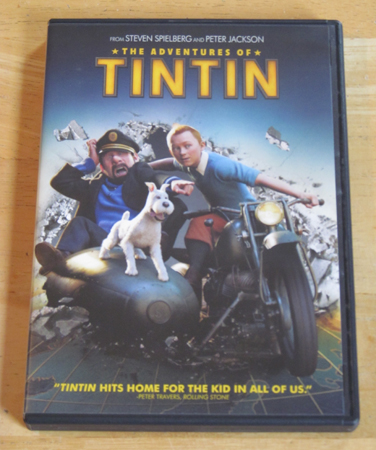
I’d never heard of TinTin until my family and I saw the Steven Spielberg / Peter Jackson movie The Adventures of TinTin that hit theaters in 2011. Such a wonderful blend of action and comedy! We enjoyed it immensely. Afterward, we hit the library and looked up the books on which the movie was based and discovered a new favorite author. Belgian cartoonist Georges Remi, under the pseudonym of Herge, had written over twenty comic-book-style books relating the many adventures of TinTin and his faithful dog, Snowy.

TinTin, a young Belgian reporter, investigates news stories all over the world, and, along with Captain Haddock, Professor Calculus, and the bumbling detective duo, Thomson and Thompson, heroically takes down the villains. The books were written from the 1930s through the 1970s, and though they are exciting and funny, they aren’t always politically correct, so be warned if you read them.

The Spielberg / Jackson movie was based on three of Herge’s books: The Secret of the Unicorn (1943), Red Rackham’s Treasure (1944), and The Crab with the Golden Claws (1941). A sequel to the TinTin movie, The Adventures of TinTin: Prisoners of the Sun, is due out in 2016. I can’t wait to see it.

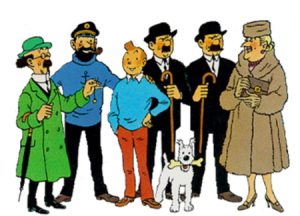
Professor Calculus, Captain Haddock, TinTin, Thomson & Thompson, Bianca Castafiore, and Snowy from Herge's The Adventures of TinTin

Professor Calculus, Captain Haddock, TinTin, Thomson & Thompson, Bianca Castafiore, and Snowy
from Herge’s The Adventures of TinTin

T_TinTinMovie

A to Z Challenge: Fictional Favorites, Day 19

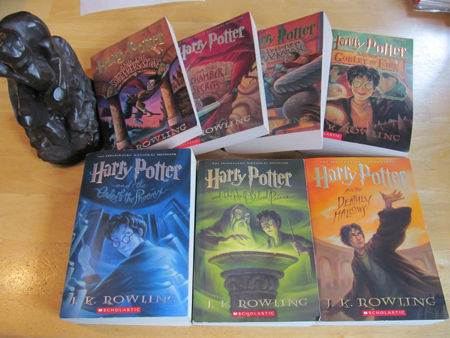
S is for — Severus Snape, from J. K. Rowling’s Harry Potter series

Out of all the many characters in Rowling’s Harry Potter series, the most complex and interesting was Severus Snape. Potions Master, Defense Against the Dark Arts teacher, Headmaster of Hogwarts School of Witchcraft and Wizardry (briefly), Half-blood Prince, member of the Order of the Phoenix, Death-Eater. Snape had many titles, but I would add another: Hero. Unbeknownst to everyone but Hogwarts Headmaster Albus Dumbledore, Snape walked a razor line between the Order of the Phoenix and the side of good, and Voldemort and the evil Death-Eaters, working tirelessly to keep Harry Potter alive because of his deep love for Harry’s mother, Lily. Yes, he initially chose the wrong path toward darkness, but the strength of his love redeemed him and brought him back from the edge of evil.

It’s no wonder he chose the dark path, considering his childhood of neglect and abuse and the bullying he suffered from James Potter (Harry’s father) and Sirius Black. They tormented him for no reason other than his unkemptness and outcast personality and his friendship with Lily, in whom James had an interest. After the bullying was revealed via Harry’s sneaking a look at Snape’s memories in the Pensieve in The Order of the Phoenix, I disliked James Potter as much as Snape did. When Harry asked Sirius about the episode, Sirius’ only excuse was that James was 15 and “A lot of people are idiots at the age of 15.” Well, I’m sorry, but being 15 is no excuse for bad behavior, and there is NO excuse for bullying, period.

After that episode, I really wanted Harry to man up and apologize to Snape for his father’s behavior. I don’t know if it would have made a difference in Snape’s treatment of Harry because Snape’s hatred of James was so deep-seated, but it seemed like the right thing to do, and I would have gained respect for Harry if he’d done it. As it was, I lost some respect for him and James and Sirius, and my opinion of them was forever colored by that incident.

Snape lived a lonely and difficult life, completely reviled and misunderstood, yet he had courage and strength of character and such capacity for love. His love for Lily, though unrequited, saved his soul. I mourned his tragic end and wondered what he would have been like if he’d had a secure and loving childhood and if Lily had loved him back. Sadly, I’ll never know.
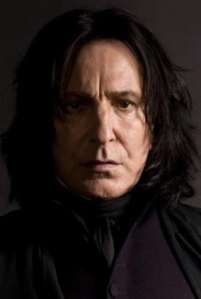
Alan Rickman as Severus Snape in the Harry Potter series Photo Credit: Harry Potter Wikia
Alan Rickman as Severus Snape
in the Harry Potter series
Photo Credit: Harry Potter Wikia

S_HarryPotterBooks

A to Z Challenge: Fictional Favorites, Day 18

R is for — Robin Hood, legendary outlaw and hero of Sherwood Forest

When someone mentions Robin Hood, my first thought is of the 1938 movie with Errol Flynn and Olivia de Havilland. I love their portrayals of Robin and Maid Marian, and there’s enough action and sword fighting for a rousing good time. Heroes of Sherwood Forest, Robin Hood and his Merry Men battle the evil Prince John and his thugs, Guy of Gisbourne and the cowardly Sheriff of Nottingham, protecting the weak and stealing from the rich to give to the poor.

As much as I love the movie, I like the book even more. I read Paul Creswick’s 1917 edition, which differs quite a bit from the movie and gives an in-depth portrayal of Robin of Locksley’s life from a young boy, through adulthood, to his sad end. The rich details and background make his story that much more compelling. The reader gets to see what made him the man he was.

According to the legend, Robin of Locksley lived during the reign of King Richard the Lionheart, who ruled England in the Middle Ages, during the twelfth century. It’s not known for certain if the legend is based on fact or fancy, but it’s the kind of story that everyone wants to believe in — where good triumphs over evil and tyranny is thrown down.

I’ve enjoyed many versions of the Robin Hood story over the years, from books, movies, and even cartoons. The most outlandish adaptation was Rocket Robin Hood, a Canadian cartoon that aired in the late 1960s and had Robin and his merry band fighting Prince John in outer space on the New Sherwood Planet Asteroid in the year 3000. My favorite version, and by far the funniest, is the 1958 Warner Brothers Merrie Melodies Robin Hood Daffy, with Daffy Duck in the title role and Porky Pig as Friar Tuck. I’ve seen it a thousand times, and it still makes me giggle like I did when I first saw it as a kid. For those who like cartoons, here’s a link to it.

Robin Hood Daffy

R_RobinHoodBook

Photo Credit: Wikipedia

Photo Credit: Wikipedia